
Staring at a mounting pile of renovation debris triggers immediate panic, but frantically searching for the cheapest dumpster rental near me without understanding the industry’s fine print is a recipe for financial disaster. With landfill tipping fees climbing and strict contract loopholes regarding weight limits and fuel surcharges becoming the norm, making an uninformed choice right now guarantees a blown budget. Mastering the nuances between national brokers and local haulers effectively neutralizes these risks, ensuring you secure the best rate possible, while a comprehensive checklist awaits at the end to keep your final negotiation watertight.
Understanding Dumpster Rental Services
Before hunting for the lowest price, it is crucial to understand what the service actually entails. Many beginners assume all bins are created equal, but the industry offers a variety of solutions tailored to different waste types and volumes. A mismatch in container size is often the primary reason people fail to get the cheapest dumpster rental near me.
What is Dumpster Rental?
Fundamentally, a dumpster rental service involves a waste management company dropping off a large steel container at a residence or job site. The customer fills it over a set period, and the company hauls it away to a landfill or sorting facility. While it sounds simple, the logistics involve fuel costs, landfill tipping fees (the cost to dump waste by weight), and driver labor. These operational costs dictate the base price.
The Mechanics of the Service
The process usually starts with assessing the debris. If a customer underestimates the volume, they might need a second haul, effectively doubling the transport cost. Conversely, renting a massive container for a small bathroom remodel is a waste of money. The service isn’t just about the metal box; it is about the logistics of disposal compliance. Understanding this chain of custody—from your driveway to the sorting facility—helps in realizing why prices fluctuate so wildly.
Types of Dumpsters Available
Knowing the hardware is half the battle. Not every project requires a massive commercial bin.
Roll-Off Dumpsters
These are the open-top rectangular bins seen at construction sites. Equipped with wheels on the rear, each unit is “rolled off” a specialized truck. This style is best for heavy volumes and temporary projects. Furthermore, most feature a swinging door at the back, allowing you to walk heavy items directly inside rather than lifting them over the rim.
Front-Load Dumpsters
Typically used for permanent commercial waste (restaurants, apartments) and emptied by a truck with front forks. These are rarely for temporary residential projects. They are the square bins with plastic lids you see behind convenience stores.
Bagsters (Soft-Sided Dumpsters)
A heavy-duty bag bought at a hardware store. The user fills it and schedules a pickup. While convenient for very small jobs, pickup fees can sometimes rival the cost of a standard bin, so compare carefully to find the cheapest dumpster rental near me.
Rubber-Wheeled Trailers
These are gentler on driveways than steel roll-off bins and are often preferred by homeowners for lighter residential cleanouts. They sit on rubber tires rather than steel rollers, significantly reducing the risk of scratching asphalt or cracking pavers.
Common Uses for Dumpster Rentals
People utilize these services for a wide spectrum of projects, each requiring a different approach to keep costs down.
Home Renovations and Remodels
Kitchen tear-outs, flooring removal, and drywall disposal are the most common drivers for rental. These materials are bulky but generally predictable in terms of weight.
Landscaping and Yard Projects
Removing dirt, concrete, sod, or tree stumps requires heavy-duty bins. Note that “clean fill” (dirt/concrete only) often has a different pricing structure than mixed trash because it can be recycled. If your project is mostly green debris, our dumpsters for yard waste guide explains which materials qualify as a “clean load,” how to avoid contamination fees, and when a dedicated yard-waste container is cheaper than mixed trash.
Estate Cleanouts and Hoarding Situations
Clearing out a home before a sale often generates high volumes of mixed household waste. These loads are often lighter than construction debris but take up immense volume due to furniture shapes.
Real-Life Scenario:
Consider Mark, a homeowner in Ohio. He decided to rent a 20-yard dumpster for a basement cleanout. He didn’t separate the heavy concrete chunks from the old furniture. When the driver picked it up, the load exceeded the 3-ton limit by two tons. Mark was hit with a $150 overage fee. Had he understood that concrete requires a different disposal strategy, he could have saved that money.
Always match the dumpster type specifically to the heaviest material you are discarding, not just the volume.
Factors Affecting Dumpster Rental Prices
Price variance in this industry is huge. One neighbor might pay $350 while another pays $600 for the exact same size bin. Understanding the variables allows a customer to manipulate them in their favor to find the cheapest dumpster rental near me.
Size and Type of Dumpster
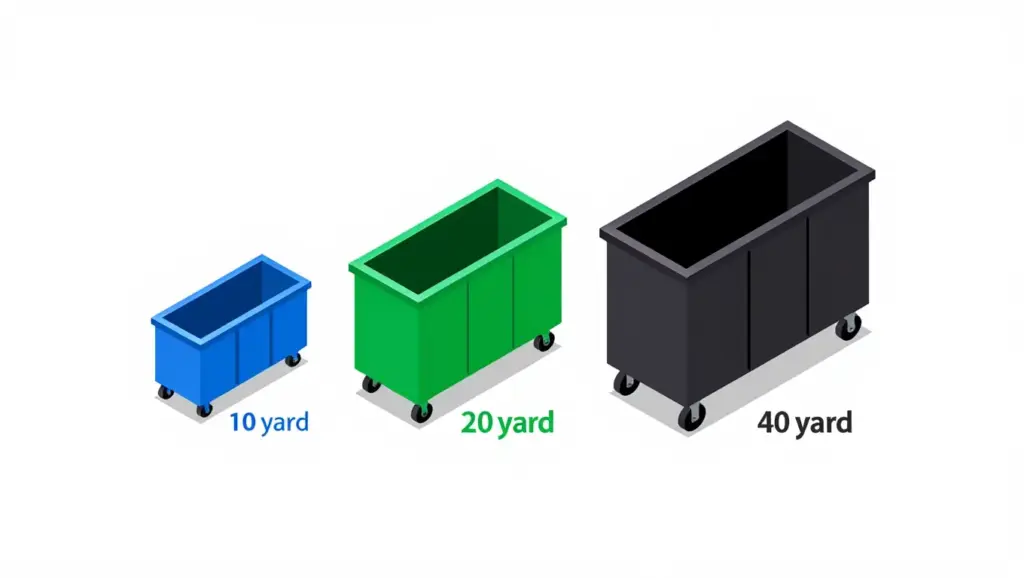
The physical size of the container is the most obvious cost factor. Pricing is usually tiered based on cubic yardage.
10-Yard Dumpster
Good for heavy debris like dirt or concrete. These are compact and fit easily in a driveway. They hold roughly 3 pickup truck loads of waste.
20-Yard Dumpster
The standard for most home projects and garage cleanouts. It provides a balance of footprint and volume, holding about 6 pickup truck loads.
30-Yard and 40-Yard Dumpsters
Reserved for whole-home demos or major construction. These bins are very tall, making them harder to load over the side, but they are essential for high-volume, low-density waste.
Loading technique matters as much as container size—poor packing can force a second haul or trigger trip fees if you exceed the fill line. This video breaks down practical steps like breaking items down, layering flat materials, and keeping debris below the rim. Use it as a checklist while you load to protect your quote.
Rental Duration
Most contracts cover a standard period, typically 7 to 10 days.
Daily Rates and Extensions
Keeping the bin past the contract date incurs daily fees, usually $10-$30 per day. It is vital to ask about this upfront. Some companies offer a “grace period,” while others charge immediately.
Early Pickup Policies
Rarely results in a discount, as the transport costs remain the same. The driver still has to come out, and the landfill fee is unchanged. However, getting it off the driveway sooner prevents neighbors from using your dumpster rental for their own trash.
Location and Accessibility
Geography plays a massive role. If the rental company has to drive 40 miles to drop off the bin, fuel surcharges will apply. Furthermore, the distance to the nearest landfill affects the price.
Urban vs. Rural Pricing
In urban areas, higher demand and difficult parking (permits required) often drive up costs. In rural areas, the base demand is lower, but higher fuel costs due to distances between the home and the dump can inflate the bill.
Seasonal Fluctuations
Summer is peak renovation season. Prices can jump 10-15% between June and August. Booking in the shoulder seasons (late fall or early spring) can sometimes yield better rates.
According to the World Bank’s municipal solid waste cost guidelines, hauling costs climb as the distance to disposal increases, and transfer stations are specifically used to reduce long-haul transportation costs in the collection system. (2024, World Bank)
Never book a dumpster without clarifying the exact weight limit included in the base price.

How to Find the Cheapest Dumpster Rental Near You
Finding a deal requires active comparison, not just clicking the first Google ad. The market is split between large national brokers and small local haulers, and knowing who is who is the key to savings.
Comparing Local Dumpster Rental Companies
There is a distinct difference between a “broker” and a “hauler.” A hauler owns the trucks and cans. A broker takes the order and subcontracts it to a hauler, adding a markup.
- Identify the Player: Brokers often have generic websites covering the entire USA. Local haulers usually have a local area code and an address in your specific county.
- The Middleman Markup: Brokers typically add 10% to 20% to the bill to cover their marketing and service. Cutting them out is the fastest way to lower the price.
- Customer Service Differences: When you call a local hauler, you are often speaking to the dispatcher or the owner. When you call a broker, you are speaking to a call center agent who may not know that your street is too narrow for a large truck.
Checking Online Reviews and Testimonials
Reviews are the best defense against predatory billing. Look specifically for comments regarding “weight overage charges.” If a company has a reputation for claiming every load was overweight, avoid them if you want the cheapest dumpster rental near me.
“All too often, Americans are plagued with unexpected and unnecessary fees they can’t escape. These junk fees now cost Americans tens of billions of dollars per year—money that corporations are extracting from working families just because they can,” said FTC Chair Lina M. Khan.
Red Flags to Watch For
- Complaints about missed pickups.
- Hidden “environmental fees” added after the fact.
- Damage to driveways without compensation.
Utilizing Discounts and Promotions
Many companies offer discounts that aren’t advertised on the homepage. You have to ask for them.
- Military/Veteran Discounts: Deeply common in the US waste industry.
- Senior Discounts: Often available for the asking.
- Contractor Rates: If a homeowner is working with a contractor, let the contractor book it; they often get volume pricing because they rent frequently.
| Feature | National Waste Brokers | Local Independent Haulers |
| Pricing Structure | Flat rate (often higher), standardized fees. | Variable, often negotiable, lower base rates. |
| Customer Service | Call centers, standardized scripts. | Direct line to the owner or dispatcher. |
| Flexibility | Strict policies on time and weight. | Often willing to extend days for free. |
| Hidden Fees | Clearly stated in fine print, strictly enforced. | Less likely to nickel-and-dime for minor issues. |
| Availability | Huge inventory, available almost anywhere. | Limited stock, can sell out in peak season. |
| Best For | Corporate accounts, multi-city projects. | Homeowners, finding the cheapest dumpster rental near me. |
Comparison Conclusion:
The table highlights that while national chains provide consistency, the local independent hauler is usually the route to the cheapest dumpster rental near me. By cutting out the middleman (the broker), the customer saves the markup fee. However, the trade-off is often a less polished booking interface and potentially older equipment. Local haulers are also more likely to understand local permit laws for street placement.
Call at least three local haulers and explicitly ask: ‘Do you offer a cash discount or a neighborhood special?’
Benefits of Renting a Dumpster Near You
While the primary goal is finding the cheapest dumpster rental near me, value isn’t just about the dollar amount. It is about efficiency, safety, and risk mitigation.
Convenience and Efficiency
The alternative to renting a dumpster is hauling waste to the dump personally using a pickup truck. This is often a false economy.
The “Do-It-Yourself” Trap
A standard pickup truck bed holds about 2 cubic yards of loosely piled debris. To remove 20 yards of waste (a standard kitchen demo), a homeowner would need to make 10 round trips. If the landfill is 45 minutes away, that is 15 hours of driving.
Opportunity Cost
Add the cost of gas for 10 trips, the wear and tear on the vehicle’s suspension, and the gate fee charged by the landfill for each entry (often $20-$50 per load). Suddenly, the dumpster rental looks incredibly cheap by comparison.
Cost-Effectiveness
When factoring in fuel, vehicle wear and tear, and the value of time, a rental often comes out cheaper than self-hauling for any project larger than a single room cleanout.
Environmentally Friendly Disposal
Professional waste management companies are regulated. They sort materials more effectively than the average homeowner can.
Recycling Protocols
Many haulers take loads to transfer stations where wood, metal, and concrete are separated before the rest goes to the landfill. This diversion reduces the overall tipping fees for the hauler, which helps keep your prices down.
Hazardous Material Safety
They ensure hazardous materials don’t end up contaminating groundwater, which protects the homeowner from legal liability. If you dump illegal items yourself, the fines are personal. When you use a reputable service, they guide you on compliance.
In a peer-reviewed life-cycle assessment of municipal waste collection route optimization in Monterrey, Mexico, researchers reported reductions of roughly 9% in greenhouse-gas emissions and about 20% in distance traveled compared with the baseline system. (2021, Universidad Autónoma de Nuevo León)
Time is money; calculate the cost of your own labor and gas before deciding to self-haul waste.
Tips for a Successful Dumpster Rental Experience
Success lies in the execution. Even if you found the cheapest dumpster rental near me, poor loading habits can lead to penalties that ruin the savings.
Properly Estimating Your Waste Volume
Visualizing cubic yards is difficult for the average person. Getting a bin that is too small leads to ordering a second one, which doubles the cost.
The Pickup Truck Rule
A helpful rule of thumb is the “pickup truck equivalent.”
- 10-Yard Dumpster: ~3 to 4 pickup truck loads.
- 20-Yard Dumpster: ~6 to 8 pickup truck loads.
- 30-Yard Dumpster: ~9 to 12 pickup truck loads.
If the debris looks like it would fill a garage halfway, a 20-yarder is the minimum safety net.
U.S. EPA’s standard volume-to-weight conversion factors show why weight limits get blown so easily: “Concrete, scrap, loose” is listed at 1,855 lb per cubic yard, while “Sheetrock scrap, loose” is 393.5 lb per cubic yard—small volume mistakes can turn into major overage charges. (2006, U.S. Environmental Protection Agency)
Understanding Rental Terms and Conditions
Contracts often contain “prohibited items” lists. Tossing a car battery or a tire into the bottom of the bin hoping no one notices is a bad strategy. Searching for a dumpster rental near me implies finding a partner, not just a bin, so check their prohibited items list to avoid steep fines.
Common Prohibited Items
- Tires: They trap methane gas in landfills.
- Batteries: Lead-acid and lithium batteries are fire hazards.
- Paints and Lacquers: Liquids cannot be landfilled.
- Asbestos: Requires specialized containment.
Avoiding Additional Fees and Charges
The goal is to keep the final bill identical to the quote. Proper estimation is the golden rule for securing the cheapest dumpster rental near me without surprise overage fees.
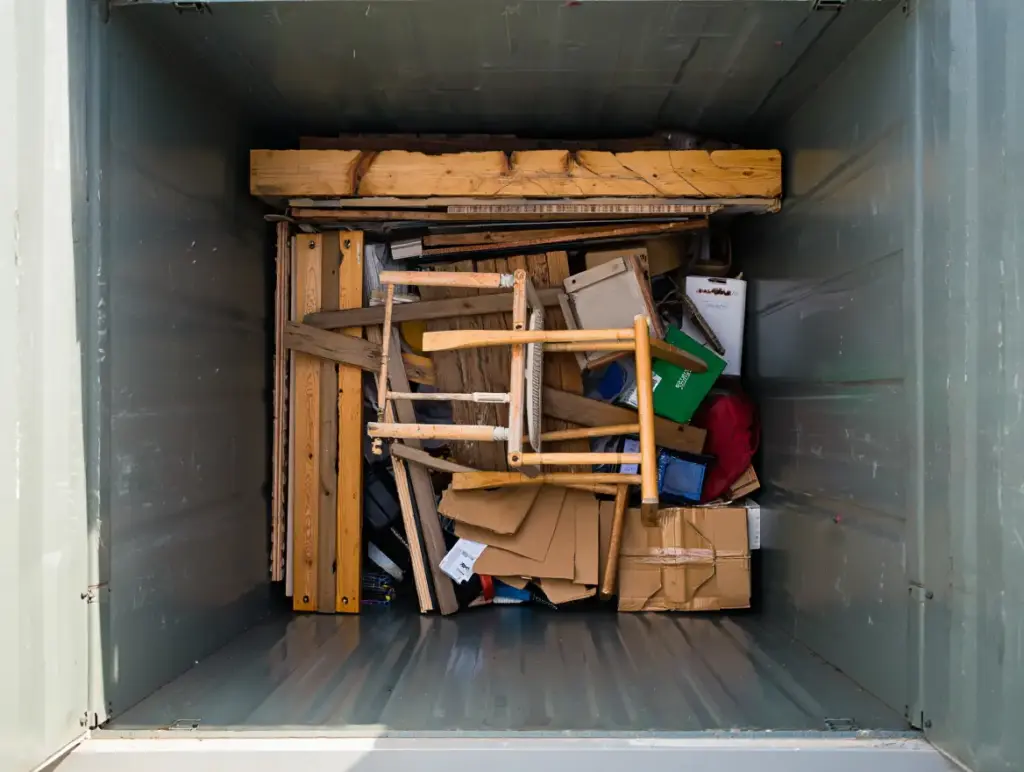
- Break It Down: Never throw a fully assembled table or cabinet into the bin. Smash it flat. Air pockets waste space.
- Load Flat to High: Place flat items (plywood, doors, drywall) at the bottom to create a smooth base.
- Fill the Gaps: Use small debris to fill the spaces between bulky furniture.
- Distribute Weight: Keep the mass evenly distributed. Do not pile all heavy concrete at the back door; it makes it dangerous to hoist the bin onto the truck.
- Watch the “Fill Line”: Never fill above the top rail. Drivers cannot legally haul a load if debris is sticking up, as it poses a road hazard. They will refuse pickup and charge a “trip fee.”
- Protect from Rain: A tarp can prevent water weight from adding tons to your bill.
Loading technique matters as much as container size—poor packing can force a second haul or trigger trip fees if you exceed the fill line. This video breaks down practical steps like breaking items down, layering flat materials, and keeping debris below the rim. Use it as a checklist while you load to protect your quote.
Real-Life Scenario:
A family in Texas was clearing out a hoarder’s estate. They threw everything in haphazardly—unbroken boxes, inflated bags, whole sofas. The 30-yard dumpster looked full, but was mostly air. They had to order a second dumpster. Had they broken down the boxes and crushed the furniture, everything would have fit in the first load, saving them $450.
Break down every single cardboard box and piece of furniture to eliminate air pockets—you are paying for volume, don’t pay for air.
Unique Offers and Value-Added Services
To stay competitive, some companies offer perks that can make a slightly higher price worth it. Sometimes the cheapest dumpster rental near me is the one that offers the best service terms, not just the lowest base dollar amount.
Same-Day Delivery Options
Disasters happen. If a pipe bursts and wet drywall needs to go immediately to prevent mold, some companies offer same-day service for a premium. This is invaluable for emergency remediation where speed is more critical than saving ten dollars.
Flexible Rental Periods
Standard rentals are 7 days. However, some homeowner-friendly franchises offer “weekend specials” (drop Friday, pick up Monday) at a reduced rate, or 3-day rentals for quick cleanouts. This is perfect for the “weekend warrior” type of homeowner.
Customizable Dumpster Solutions
- Driveway Protection: Some companies place wooden boards under the wheels to prevent cracking the asphalt.
- Locking Lids: Essential in urban areas to prevent neighbors from throwing their trash into your rented bin.
- Compact Trucks: Specialized hook-lift trucks that can fit into tight city alleys where standard roll-off trucks cannot maneuver.
If you are in a high-density area, ask for a locking bar to prevent unauthorized dumping by neighbors.
Frequently Asked Questions About Dumpster Rentals
This section addresses the logistical hurdles that often trip up first-time renters.
What Can and Cannot Be Disposed Of?
Generally, household junk, construction debris, and yard waste are fine.
- Prohibited: Tires, batteries, paint (unless dried), oil, asbestos, medical waste, and appliances with Freon (refrigerators/AC units).
- Gray Areas: Mattresses often incur a surcharge ($20-$50) because they clog landfill compactors.
How to Schedule a Dumpster Pickup?
Most companies do not automatically pick up the bin. The customer must call 24-48 hours in advance to schedule removal. If the customer forgets to call, the bin sits there, potentially accruing daily rental fees.
What Happens if I Exceed the Weight Limit?
The truck weighs in at the landfill entrance and exit. The difference is the cargo mass. If the allowance was 2 tons and the waste weighs 3 tons, the customer is billed for the extra ton at the current market rate (pro-rated).
Waste Business Journal’s November 2022 tipping-fee update reported landfill pricing up 5.4% year-to-date (with privately owned landfills up 6.1%), reinforcing why staying under the included tonnage is the fastest way to control your final bill. (2022, Waste Business Journal)
FAQ: Quick Answers for Smart Renting
1. How much does a standard dumpster rental usually cost?
It varies wildly by region, but generally, a 10-yard dumpster ranges from $300 to $450, while a 20-yard dumpster runs between $380 and $550. Coastal cities will be on the higher end, while the Midwest and South will be lower.
2. Why is the 20-yard dumpster the most popular choice?
It hits the “sweet spot” of capacity and footprint. It is large enough to hold debris from a kitchen remodel or a multi-room cleanout but small enough to fit comfortably in a standard residential driveway without blocking the sidewalk.
3. What is the difference between flat-rate and variable pricing?
Flat-rate pricing bundles the rental, delivery, pickup, and taxes into one number (up to a weight limit). Variable pricing charges for the haul separately from the disposal weight. Flat-rate is safer for homeowners; variable is often better for contractors who know their exact weights.
4. Does rain make my dumpster heavier and cost more?
Yes, it can. Debris like mattresses, upholstery, and wood acts like a sponge. A heavy rainstorm can add hundreds of pounds of water weight to the load. It is wise to throw a tarp over the bin if rain is in the forecast.
5. Do I need to be home for delivery or pickup?
Usually, no. As long as the spot is clear of cars and accessible, the driver can drop the bin. However, being there allows you to direct the driver to the exact spot you want, ensuring you can still open your garage door.
Most “surprise charges” come from prohibited items that renters assume are fine—until the landfill rejects the load or the hauler adds a surcharge. This video clarifies common restrictions and helps you avoid expensive mistakes. Watch it before you start tossing “gray area” items into the bottom of the bin.
Conclusion
Securing the cheapest dumpster rental near me is about more than just the sticker price; it is about avoiding the hidden costs of weight overages, prohibited items, and inefficient loading. By correctly estimating the volume, preparing the materials properly, and choosing a local hauler over a national broker, a homeowner can manage their waste for significantly less money. The smart approach is to measure twice, cut once, and pack tight.
Now is the time to assess the scope of the project. Walk through the house or job site and be realistic about what is being thrown away. Call three local providers today, ask about their weight limits, and lock in a rate before the seasonal rush begins.
For those ready to start calling, having a script and a checklist ensures no critical questions are missed. Download the “Dumpster Rental Cost-Saving Checklist” below. It covers the 15 essential questions to ask a hauler and includes a volume estimation grid.

What’s the strangest thing you’ve ever had to figure out how to dispose of? Drop a comment below—let’s see who had the toughest haul!
Sources
- World Bank (2024). Municipal Solid Waste Cost Calculation Technical Guidelines for Low- and Middle-Income Countries.
- Benitez-Bravo, R., et al. (2021). Optimization of municipal solid waste collection routes in a Latin-American context. (Journal of the Air & Waste Management Association).
- U.S. Environmental Protection Agency (2006). Standard Volume-to-Weight Conversion Factors.
- Waste Business Journal (2022). Big Gains in Landfill Disposal Pricing; Up 6% for the Year…
- Khan, Lina M. (2023). FTC Proposes Rule to Ban Junk Fees. (Federal Trade Commission press release).